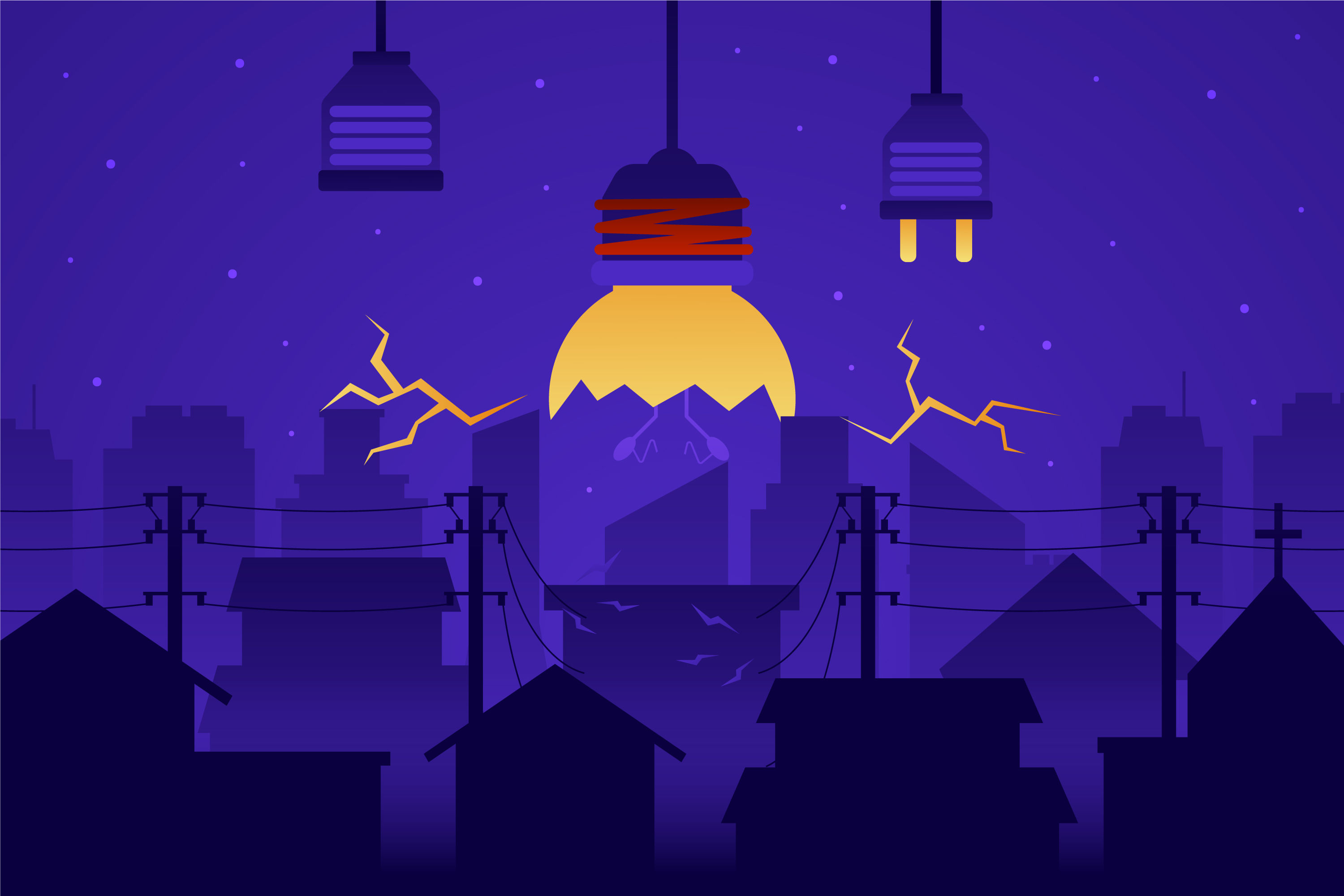
What is a blackout and why it affects more than electricity
A blackout is a large scale and unplanned loss of electrical power affecting cities, regions, or sometimes entire countries. Unlike a local outage caused by a damaged line or a single transformer failure, a blackout impacts many parts of the power system at the same time. Electricity generation, transmission, and distribution stop working together, and restoring power requires coordinated system wide action.
In everyday terms, a blackout is never just about lights going off. Electricity quietly supports almost every essential service we rely on. When power disappears, heating systems stop working, water pressure drops as pumping stations shut down, and telecommunications infrastructure begins to degrade. In many regions, access to clean water depends directly on electrically powered treatment plants. Payment systems rely on data centers and digital networks. Fuel stations cannot operate pumps without power. Hospitals, logistics hubs, and industrial facilities move into emergency operating modes within minutes.
This is why blackouts are best understood as a human issue rather than a purely technical event. They interrupt daily routines, slow down businesses, and affect access to essential services all at once. Understanding this broader impact helps replace fear with clarity and opens the door to realistic preparation.
Blackout vs power outage. A critical difference
Not every interruption of electricity supply qualifies as a blackout.
A standard power outage is usually local and limited in scope. Grid operators can identify the fault, isolate the affected section, and restore service using established procedures, often within hours.
A blackout is different by nature. It is systemic rather than local. It occurs when the balance between electricity generation and consumption collapses across a wide area. To protect equipment, power plants disconnect automatically and transmission lines shut down. This creates a cascading effect, where one shutdown triggers stress and instability elsewhere in the system.
Restoring power after a blackout is complex and gradual. It requires power plants capable of black start, meaning they can operate without external electricity. Operators must then re-energize parts of the grid step by step, carefully synchronizing voltage and frequency. In interconnected european power systems, this coordination often spans multiple countries and operators, making the process more demanding than a typical outage repair.
How modern power grids work and why balance matters
The electricity grid works like a living nervous system. At every moment, the amount of electricity produced must closely match the amount being consumed. If demand exceeds supply, system frequency drops. If supply exceeds demand, frequency rises.
Both situations can damage equipment and trigger automatic protective shutdowns.
In traditional centralized systems, balancing was managed mainly through large conventional power plants. Today’s energy landscape is far more dynamic. Renewable energy sources, especially wind and solar, are weather dependent and geographically dispersed. Energy flows are increasingly bidirectional, and digital control systems manage thousands of assets in real time.
This evolution brings clear benefits in efficiency, sustainability, and flexibility. At the same time, it increases the need for coordination and resilience. Small disturbances can spread more quickly if systems are not properly synchronized or protected. Recognizing this complexity helps explain why modern energy systems focus less on perfection and more on the ability to adapt.
Cyber risks and the digital layer of energy infrastructure
Modern energy systems rely heavily on digital control. Operational technology systems monitor and manage power plants, substations, and distribution networks. These systems were once physically isolated. Today, they are increasingly connected to corporate IT environments, cloud platforms, and remote service tools that support monitoring and maintenance.
This connectivity improves efficiency and visibility, but it also expands the digital surface that needs protection. Cyber incidents targeting the energy sector rarely aim to cause immediate blackouts. More often, they focus on gaining access, observing system behavior, testing defenses, or exploiting known vulnerabilities that were never fully addressed.
A system does not need to be completely taken offline to create instability. Manipulating operational data, disabling monitoring functions, or triggering false alarms across several locations can place strain on both operators and automated control mechanisms. When such digital disturbances coincide with high demand or extreme weather, the risk of broader disruption increases.
For this reason, cybersecurity is no longer treated as a purely IT topic. It is now recognized as a core element of energy resilience.
Analyses such as Cyber attacks on the energy sector: securing critical infrastructure from digital threats show how digital weaknesses can translate into real operational risk for modern energy infrastructure
Blackouts do not start at the wall socket
From the user’s point of view, a blackout feels sudden. From a system perspective, it is usually the result of accumulated stress. Weather events, aging equipment, operational errors, cyber incidents, and unexpected demand patterns interact in complex ways.
Heat waves increase air conditioning demand while reducing transmission efficiency.
Droughts limit hydropower output. Cold winters raise heating loads. Delayed maintenance reduces system margins. None of these factors alone causes a blackout. Together, they can push a complex system beyond its stable operating range.
This is not a failure of progress. It is a natural feature of highly interconnected systems. Recognizing this reality allows for better preparation without panic.
Energy resilience instead of fear driven narratives
Preparing for blackouts does not mean expecting them every day. It means acknowledging that no system is immune to disruption and planning accordingly. Resillience is about maintaining essential functions even when conditions are not ideal.
For governments and grid operators, resilience involves redundancy, diversification of energy sources, cross border cooperation, and regular testing of emergency procedures. For companies and institutions, it means protecting critical processes. For households, it starts with understanding basic dependencies and having simple backup options.
The goal is not independence from the grid, but flexibility when the grid is temporarily unavailable.
The role of backup power in modern energy systems
Backup power systems are a practical response to uncertainty. They do not compete with renewable energy or centralized grids. They complement them.
A backup power generator supplies electricity when the main grid is interrupted. Depending on configuration, it can support selected critical loads or entire facilities. In industrial and commercial environments, backup power protects production continuity, data integrity, and safety systems. In healthcare and public infrastructure, it supports life critical equipment. In residential settings, it helps maintain heating, refrigeration, and communication during extended outages.
Backup power is not about luxury. It is about preserving normality when conditions change.
Why backup power generators are no longer a niche solution
In the past, generators were associated mainly with construction sites or emergency services.
Today, backup power generators are increasingly integrated into broader energy strategies across many sectors.
Digitalization has increased sensitivity to even short power interruptions. Remote work, automated production, and data driven operations depend on stable electricity. Climte variability introduces new stress patterns. Decentralized energy production requires flexible balancing tools.
Backup power generators provide predictability. When power is lost, they respond according to predefined logic. This reduces operational stress and allows people to focus on their tasks instead of the power supply.
Backup power does not replace the grid
A generator is not designed to replace the grid permanently. Its role is to bridge gaps. Its value lies in the transition period between disruption and restoration.
Effective backup power planning focuses on critical loads rather than total capacity. Heating systems, pumps, control electronics, servers, safety systems, and essential lighting usually take priority. This approach optimizes generator size, fuel consumption, and operating costs.
Proper integration matters. Automatic transfer switches, load prioritization, and correct installation ensure smooth operation without manual intervention.
Human centered energy planning
Energy systems ultimately exist to serve people. When power fails, the impact is felt in comfort, safety, and trust. Businesses value predictability. Families value warmth and water. Institutions value reliability.
Backup power planning reflects responsibility toward users, employees, and communities. It reduces uncertainty and supports calm decision making. Instead of asking what could go wrong, the focus shifts to how continuity can be maintained.
Backup power in different environments
In industrial facilities, backup power generators protect production lines and prevent costly downtime. In agriculture, electricity supports ventilation, irrigation, and storage, protecting both livestock and crops. In commercial buildings, generators maintain IT systems, security, and climate control, which is critical for data centers and logistics operations. In residential environments, backup power ensures basic comfort during extended outages, especially in regions with harsh winters or limited grid redundancy.
Choosing the right backup power solution
Choosing the right backup power solution is rarely about buying the largest generator available. What matters is understanding how energy is actually used, which systems are critical, and how long they need to operate independently.
Load profiles differ significantly. Some systems require high starting power but low continuous consumption. Others run steadily for long periods. Runtime expectations influence fuel storage, cooling, and maintenance planning. Fuel type, noise constraints, and local regulations also play an important role.
Integration with existing systems determines whether backup power behaves smoothly during a real outage. Automatic transfer, load management, and monitoring are not add-ons but essential elements. In decentralized and mobile environments, flexibility matters more than raw capacity.
Approaches used in modular IT and off grid deployments show how thoughtful generator design supports real world use cases, as described in Data center in a box: 7 genius off grid generator hacks for mobile IT
Maintenance access and compliance cannot be overlooked.
Backup power generators are infrastructure, not one time purchases.
When specified correctly, they quietly become part of the system and simply work when needed.
Energy resilience as a shared responsibility
Blackouts are rare, but their consequences can be significant. Understanding how modern energy systems work helps remove unnecessary fear. Backup power generators are not symbols of distrust in the grid. They are practical tools that support continuity, safety, and calm responses when disruptions occur.
Energy resilience is built through cooperation between grids, technologies, and people. Backup power is one of the simplest and most effective elements of that cooperation.
At ElectroQuell, backup power is treated as part of responsible energy planning. Not because failure is expected, but because being prepared makes operations calmer and decisions easier. For organizations that rely on predictable performance, diesel generator units remain one of the most proven and reliable solutions for maintaining continuity when the grid is under pressure.
If you want to explore how backup power generators can support your infrastructure in practice, the ElectroQuell generator portfolio offers solutions designed for real operating conditions. The team also shares practical insights and case driven discussions on LinkedIn. No urgency. No drama. Just solid energy planning for people who prefer readiness over last minute improvisation.
