It's Friday, 6:40 PM.
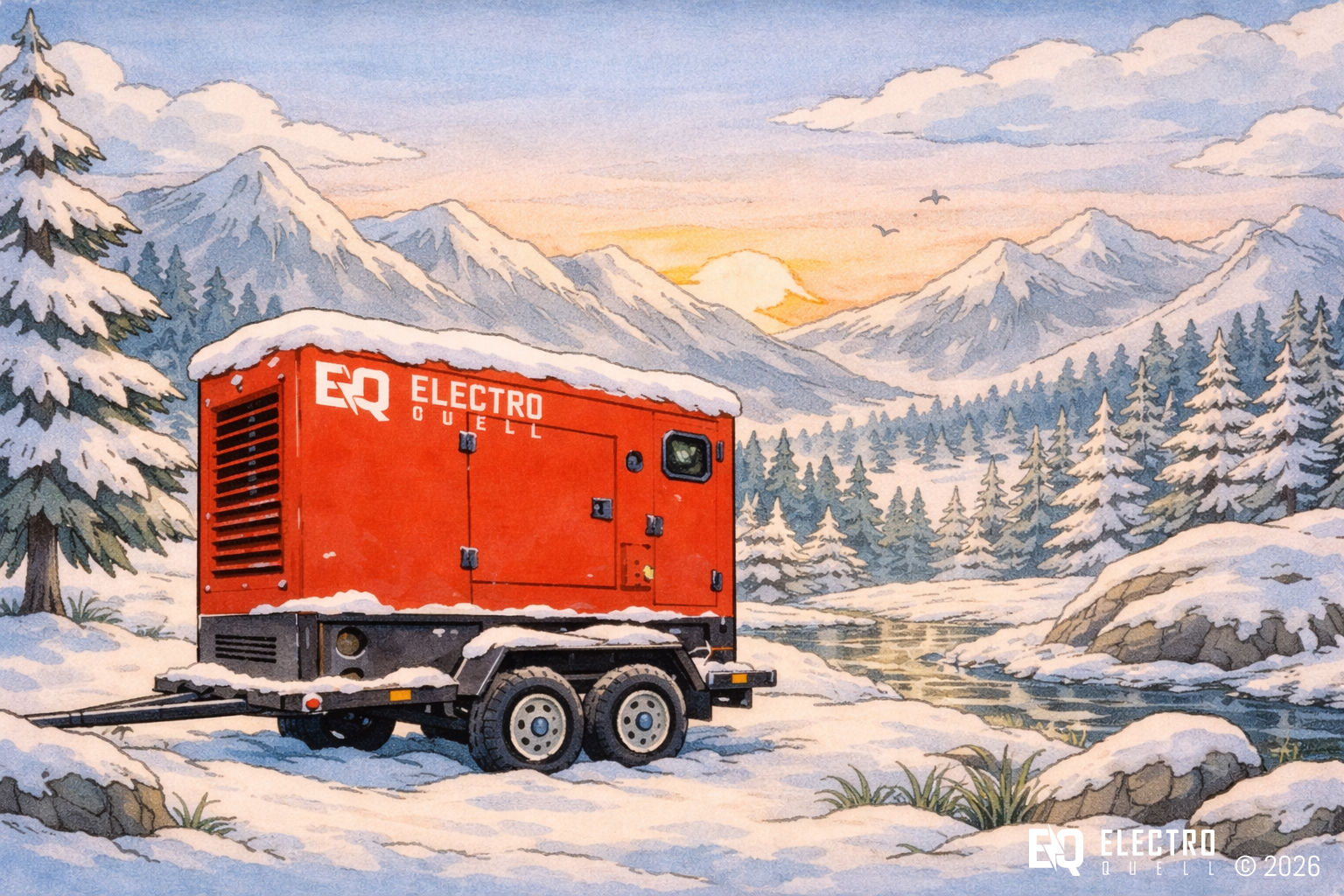
A mountain hotel is preparing for full occupancy. The power grid in the region has been unstable for several days following heavy snowfall. The facility management decided to proactively start up a mobile reserve unit positioned in the technical parking lot.
Not because the power had already failed.
But because responsibility begins before the problem appears.
A containerized generator set on a twin-axle trailer is meant to secure the kitchen, HVAC systems, pump rooms, access control systems, and IT infrastructure. Formally, this isn't a critical infrastructure facility. Operationally, for the owner, it is.
The temperature drops to minus twelve degrees Celsius.
The engine starts, but noticeably harder than in autumn. The starting sound is longer, more 'sticky'. It's not a failure. It's the difference in operating conditions.
At this moment, the real question begins: was the unit designed and prepared for operation in sub-zero temperatures, or was it simply placed there as a safeguard?
Winter preparation isn't about reacting. It's about designing the scenario.
Mobility of the generator changes everything
A stationary unit inside a technical building functions in a controlled environment. It has a dedicated space, a temperature usually maintained above +5°C, often closer to +10°C. Support systems, battery chargers, and operational parameter monitoring are integrated with the facility's infrastructure. Diesel power generators in such a configuration operate in a predictable environment.
A mobile diesel power generator operates in completely different realities.
It stands in an open space.
It is directly exposed to wind.
It cools down exactly to the ambient temperature.
It often lacks a permanent auxiliary power connection.
If the temperature drops to -15°C at night, then the engine block, oil pan, fuel filter, and alternator housing are at -15°C. Not 'almost'. Not 'around zero'. Exactly that temperature.
At -15°C, the viscosity of engine oil increases many times over compared to a reference temperature, e.g., +20°C. This means significantly higher resistance during startup. The starter motor must overcome greater friction, and the oil film builds up more slowly in the first seconds of operation.
A battery at -10°C can lose 30–40% of its effective capacity. At -20°C, this drop can be even greater. A mobile diesel power generator in winter doesn't need less energy to start. It needs more. And the battery offers less.
Air density increases as temperature drops. Theoretically, this means more oxygen in the same volume. In practice, it changes the combustion characteristics in a cold combustion chamber. If the engine starts with a block temperature of -12°C, the ignition process proceeds differently than at +15°C.
Structural materials contract. Seals harden.
Threaded connections work within different tolerances.
In a stationary unit, these changes are cushioned by stable ambient conditions. In a mobile unit, standing in a technical parking lot or near an industrial facility, diesel power generators for low-temperature operation must be consciously prepared.
Mobility offers flexibility. You can move the unit where it's needed. You can secure seasonal demand peaks. You can provide a temporary power source during a grid connection upgrade.
But mobility removes the comfort of stable conditions.
❌ No walls maintaining a temperature of +8°C.
❌ No permanent 24/7 battery charger unless previously planned for.
❌ No natural protection from wind at 60 km/h at -10°C.
Therefore, a mobile diesel power generator operated in winter must be treated as a system operating in an outdoor environment, not as a 'portable version' of a stationary unit.
If the project accounts for real conditions: -15°C, high humidity, wind, lack of permanent auxiliary power, then technical decisions start to look different. An engine heater ceases to be an option. It becomes an element of system logic. Regular start-up tests at -5°C cease to be a formality. They become a test of real readiness.
Mobility is not a problem. It's a parameter.
And parameters must be accounted for at the planning stage, not at the moment when a mobile diesel power generator at -18°C cranks one second too long.
Container housing and actual winter protection
Many users assume that since a mobile diesel power generator has a container housing, the winter issue is settled. There are doors, there is a roof, snow doesn't fall directly on the engine. The logic seems simple.
The problem is that acoustic enclosures are designed primarily for noise reduction and weather protection. Their main task is to meet environmental requirements and provide mechanical safety. Thermal insulation properties are often secondary.
A container is not a heated engine room.
In the context of operation at -10°C, -15°C, or -20°C, completely different parameters matter than during acoustic tests.
The first issue is structural tightness.
It's not about hermetic sealing—the engine needs air. It's about controlled infiltration. If air is blown through gaps around service doors at -12°C with wind speeds of 50 km/h, the interior cools down much faster than anticipated at the design stage.
The second matter is limiting cold air inflow during standstill.
In practice, a mobile diesel power generator in winter often operates cyclically. A few hours of operation, a few hours of rest. During standstill, the container interior should be protected from free airflow.
Seal resistance to sub-zero temperatures is another detail that ceases to be a detail in February. Low-quality seal materials harden at -10°C, lose elasticity, and stop fulfilling their function. It doesn't look spectacular. The doors just let a bit of air through.
And that's enough for the internal temperature to drop by a few additional degrees.
Equally important is the ability to close ventilation dampers during standstill in a controlled manner. In many designs, air intakes are permanently open. It's a simple solution, but during prolonged frosts, it means the entire engine block cools down faster than necessary.
In practice, it's worth checking a few things before the temperature drops below -5°C.
✔️ Whether the service doors, when closed, actually seal evenly around the entire perimeter.
✔️ Whether air intakes are protected from blowing snow that could block the grilles.
✔️ Whether moisture appears inside the housing after operation ceases.
Condensation is a topic that is often underestimated.
After several hours of operation, the container interior can reach +30°C, while outside it's -8°C. When the engine is shut down, warm air contacts the chilled walls. Water vapor condenses on metal components, on hoses, on controller housings.
In the case of diesel power generators equipped with advanced control systems, moisture can affect electronics, connectors, and communication modules. It's not a failure 'immediately'. It's a gradual degradation of operating conditions.
Professional solutions include thermal insulation of container walls. Not always full insulation, as in a building, but sufficient to limit rapid temperature changes inside.
Increasingly, minimal internal temperature maintenance systems are used, maintaining e.g., +5°C during standstill with an external temperature of -15°C. It's a small difference from a human comfort perspective, but enormous from the perspective of engine starting and electronics durability.
Equally important is control of condensate drainage. Drain holes must be clear. If condensate freezes in the wrong place at -10°C, it can lead to mechanical damage or blockage of moving components.
In the context of mobile applications, it's worth remembering that diesel power generators are often moved between locations with different climatic conditions. One week they operate at +3°C and high humidity, the next at -18°C in dry, freezing air. The housing must handle this range without user improvisation.
These are all elements that directly affect winter reliability.
Because a container protects against snow.
But only a consciously designed housing protects against the effects of -15°C for several consecutive nights.
Ventilation: the balance between cooling and chilling
A diesel engine does not operate in thermal silence. Under load, it generates a significant amount of heat.
The alternator also releases energy in the form of thermal losses. In a unit rated at several hundred kVA, we are talking about tens of kilowatts of energy that must be effectively dissipated.
During operation, ventilation must ensure adequate airflow to:
-
Maintain coolant temperature within the design range, typically 80–95°C,
-
Ensure proper cooling of the alternator windings,
-
Maintain stable temperatures for electronic components,
-
Remove excess heat from the container space to prevent local hotspots.
In a stationary unit, ventilation ducts are designed for a specific room.
In a mobile diesel power generator, this entire system is integrated into the housing.
Every air inlet and outlet is a compromise between cooling efficiency and protection from external conditions.
In winter, this compromise becomes more pronounced.
During operation at -10°C, the air drawn into the container is denser and colder.
On one hand, this facilitates heat dissipation. On the other hand, it creates greater temperature differentials between the interior and the surroundings. Metal components in the intake zones can operate at significantly lower temperatures than the engine block. Local thermal gradients develop.
During standstill, the situation reverses. If air inlets remain fully open and the temperature drops to -15°C, the entire interior of the enclosure quickly assumes the external temperature.
The engine block, alternator, controllers, and batteries cool uniformly to ambient level.
A mobile diesel power generator that was operating with a coolant temperature of 85°C just a few hours earlier is, after a night at -18°C, in a fundamentally different thermal state.
The optimal approach lies in controlling this process, not passively accepting the conditions.
Adjustable air dampers allow for limiting the inflow of cold air during standstill without disrupting airflow during operation. This is a simple mechanical solution that has a massive impact on cooling dynamics.
Automatic ventilation control based on ambient temperature and internal enclosure temperature enables more precise microclimate management.
At -5°C, airflow requirements may differ from those at -20°C. A mobile generator operated year-round should respond to these differences, not operate in a binary on/off mode.
Also critical is the separation of engine cooling channels from the alternator and controller compartments.
In some designs, airflow is shared, which simplifies construction but makes temperature control in specific zones difficult. In winter, this can lead to situations where the alternator is aggressively cooled during standstill, while the engine requires a different approach.
In projects with elevated requirements, temperature sensors are placed at multiple points within the enclosure.
For example: near the engine zone, at the alternator, close to the batteries, and at the air intakes. Data from these sensors makes it possible to assess whether temperature distribution is uniform or if there are zones of excessive cooling.
This is especially important in mobile applications, where diesel power generators may operate under variable loads and in shifting climatic conditions. One day at -3°C, the next at -17°C with strong wind.
A lack of ventilation control leads to two extremes:
❌Overheating during operation.
If a user, fearing excessive cooling, restricts the air intake without analyzing airflow, the coolant temperature may rise above permissible limits. In extreme cases, this triggers high-temperature alarms, power derating, or unit shutdown.
❌Excessive cooling during standstill.
Each subsequent night at -15°C lengthens start-up time, increases battery load, and causes the mobile diesel power generator in winter to behave less predictably.
Ventilation in a mobile unit is not merely an opening in a container wall. It is a system that determines whether a diesel power generator at -20°C will be ready to start on the first turn of the key, or after three attempts and a short prayer to physics.
Start-up temperature: engine, fuel, and batteries as one system
If ventilation determines what happens to heat during operation, then pre-heating determines the thermal state in which a mobile diesel power generator begins its day.
And that is a fundamental difference.
A diesel engine does not like starting work at -15°C. Yes, it can do it. It is constructed to do so. But the question is not whether it will start, but how it starts and at what cost to its components.
An engine block heater is one of the most effective solutions for winter starting. Maintaining the coolant at +10°C to +20°C means that a mobile diesel power generator in January behaves more like it does in November than like an arctic experiment.
The difference is clear.
Start-up time shortens noticeably.
Battery load decreases.
The combustion process in the first seconds of operation is more stable.
Mechanical wear on cylinders and piston rings is reduced.
An engine starting with a coolant temperature of +15°C reaches proper lubrication conditions faster.
Oil achieves its target viscosity faster than at -12°C. The oil film builds more efficiently. These are seconds that, from a durability perspective, matter.
In mobile units, however, an additional thread appears: power supply for the heater.
Unlike a stationary generator, which has a permanent auxiliary connection, a mobile diesel power generator on a trailer does not always have energy available for temperature maintenance.
This forces a design decision.
Either a permanent 230 V auxiliary connection is provided, maintaining the battery charger and engine heater in continuous mode.
Or autonomous fuel-powered heating systems, independent of the grid, are used.
In facilities with high operational requirements, the lack of pre-heating is no longer a neutral option. It is a conscious acceptance of increased risk that at -18°C, the mobile diesel power generator will need two start attempts instead of one.
The cost of maintaining temperature is usually negligible compared to the cost of downtime for the system it was meant to protect.
But the engine is only part of the equation.
Fuel: a medium that doesn't like improvisation
Fuel parameters directly affect engine operation. At sub-zero temperatures, paraffin crystallization occurs in diesel fuel. This process leads to restricted flow through the fuel filter.
This phenomenon isn't spectacular.
The engine doesn't explode. It simply starts running unevenly or stalls under load.
And a mobile diesel power generator for low-temperature operation is meant to run stably, not experimentally.
Therefore, fuel must be adapted to the season and region. In EU, winter-grade fuel is designed for a specific temperature range, but a mobile unit may travel between regions with different climatic conditions. What works at -5°C on the coast may not suffice at -20°C in the mountains.
It is essential to:
✔️ Not leave transitional fuel in the tank for many weeks,
✔️ Inspect filter condition before the winter season,
✔️ Avoid mixing fuel without awareness of its parameters.
In more demanding applications, heated fuel filters and fuel tank temperature monitoring are used. These are solutions that significantly increase operational predictability.
A mobile diesel power generator in winter is only as stable as the fuel that powers it.
Batteries: chemistry doesn't negotiate with temperature
If the engine and fuel are prepared, one link in the chain remains: the battery.
At -10°C, effective capacity can drop to about 70% of nominal value. At -20°C, the drop is even greater. At the same time, starting requires more current because oil viscosity has increased.
That's the mathematics of winter.
Seasonal preparation involves more than a quick voltage check.
A resting voltage of 12.6 V doesn't tell the whole story.
A load test is fundamental. It shows whether the battery can deliver the required current at low temperature.
In mobile configurations lacking a permanent connection, regular battery charging must be planned. A battery left for several weeks at -8°C without maintenance can lose a significant portion of its performance.
In units with elevated requirements, dual battery sets or redundant starting systems are used.
That's an element of the business continuity plan.
From coolant temperature.
Through fuel quality.
To battery condition and starter motor efficiency.
Winter start-up is a test of the entire chain.
If any of these elements are treated marginally, your mobile generator at -17°C will remind you that physics always works.
The good news is that all these phenomena are predictable. And since they are predictable, they can be accounted for at the planning stage, not at the moment when the low-voltage warning light starts blinking faster than expected.
Winter is a joyful time!
Let's return for a moment to the mountain hotel.
The generator took over the load smoothly. Voltage parameters are within tolerance. Frequency stable. The kitchen is running. HVAC systems maintain the temperature. The guests don't know that the building operated in backup power mode for several hours.
And that's exactly how it should be.
A well-prepared mobile diesel power generator isn't the hero of the situation. It doesn't impress. It doesn't require improvisation. It simply works when it's needed.
Mobility offers tremendous flexibility.
Diesel power generators on trailers allow you to secure seasonal facilities, temporary investments, grid connection upgrades, and situations requiring rapid response. But this flexibility requires awareness of operating conditions.
If a mobile generator is to be a real element of a business continuity plan, it must be prepared for real temperatures, real wind, and real loads. For harsh frosts, not a mild winter.
At ElectroQuell, we design and deliver solutions with precisely these scenarios in mind.
Our range includes both stationary diesel power generators and mobile trailer-mounted units adapted for operation in demanding climatic conditions. Configuration doesn't end with rated power. It includes the enclosure, heating systems, ventilation, starting systems, and real operating conditions.
If you are interested in specific projects, configurations of mobile units, and examples of applications in various operational environments, we invite you to join the ElectroQuell community on LinkedIn.
There, we regularly showcase projects, implementations, and the practical aspects of working with diesel power generators in the field.
Because in the power industry, it's all about consistent continuity.